Nick Courage: I know that you're a little hesitant about getting interviewed, so I'm gonna start off with a few soft balls. First one: there are a lot of fans of Murray the Cat here on AMR, but I don't think most people know that you're both his godfather and namesake. Before we get into the personal present, can you talk a little bit about the onomatology (name-history/significance) of "Murray Lerch"?
Scott Lerch: Anything not related to computers or science is probably not a soft ball question for me but I'll do my best. For some reason I've been honored with having Django Murray Lerch named after me, Scott Murray Lerch. All I did was tag along when you picked up Murray and Velcro at a shelter in the freezing winter of Boston during a short visit. Although, I guess I probably did encourage the whole thing since I love kitties with two of my own now by marriage. I got the name Murray from my father who got it from his great-great grandfather who was a captain for the Union in the civil war, but I know little else beyond that. Still that's probably way more history for a cat's name than most.
Nick Courage: I didn't realize there was an American history background other than the scan/seek button on the radio thing (which is the default story I tell). Did I just make that up?
Scott Lerch: Not exactly. My grandfather, Charles Lerch, did invent the radio seek button used in cars today, but he doesn't carry the name Murray. Since your cat's full name includes Lerch, I guess the story is still valid. Now thanks to Google patent search you can even back up your claim (US Patent 2,843,734), which is useful for me too since some people are incredulous when I tell them the story. It must sound like just the right balance of mundane and grandiose (in a weird sort of way) that it has to be made up.
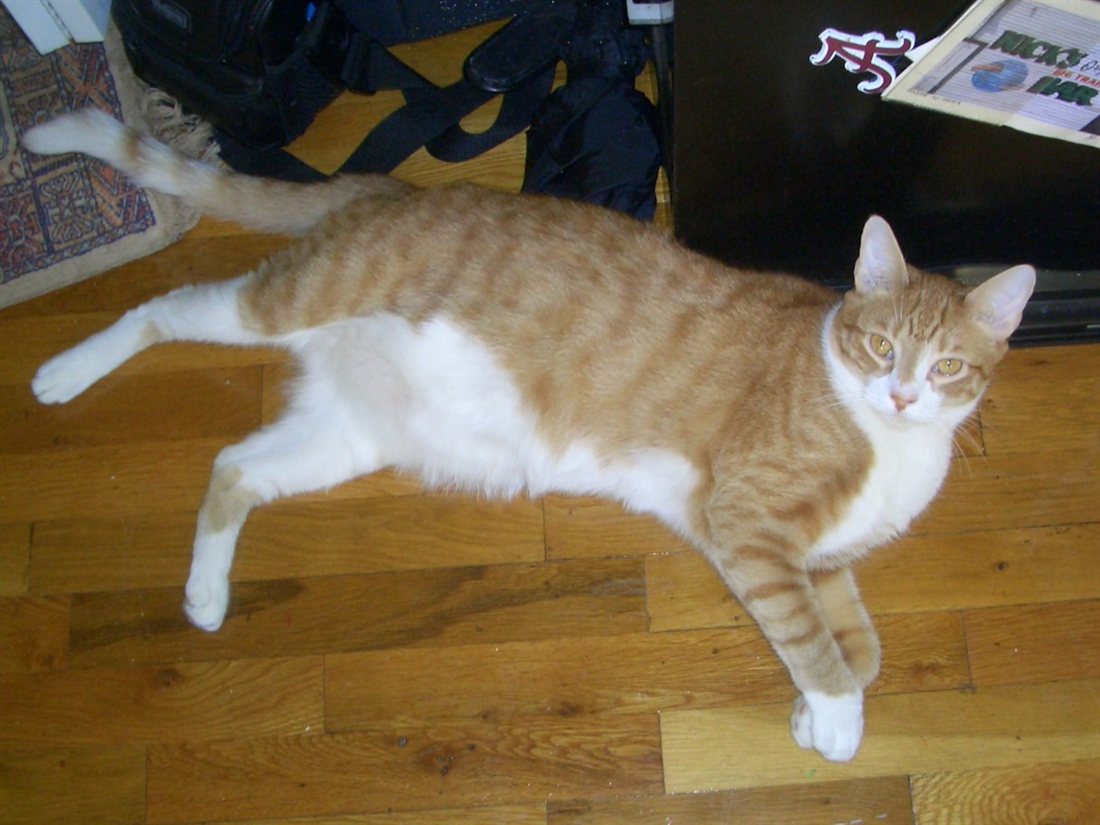
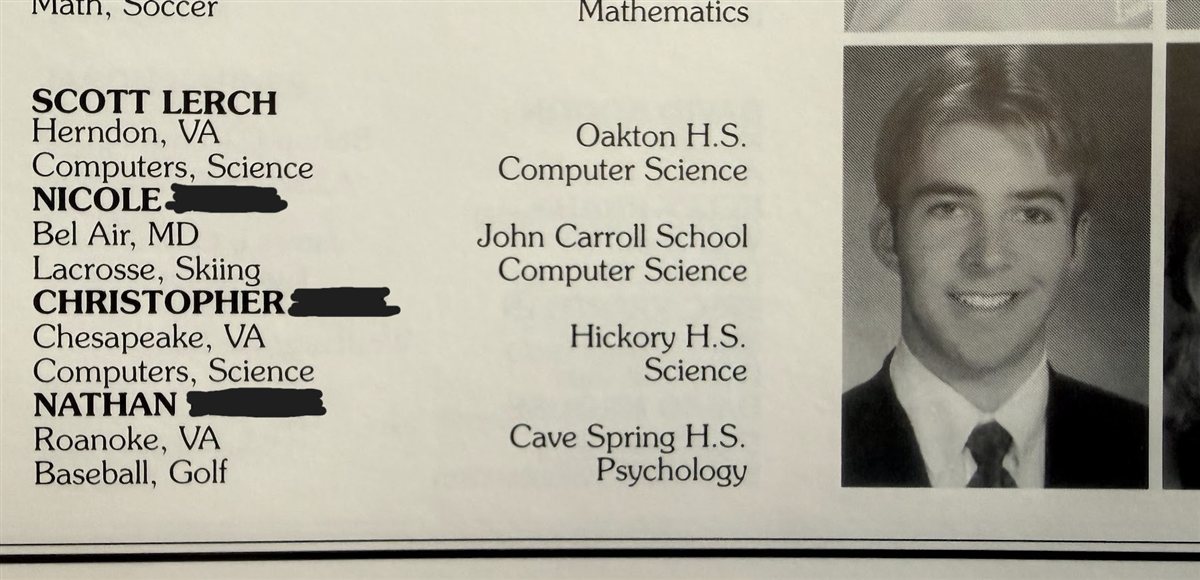
Nick Courage: For all of you out there reading: this is Murray the Cat's pedigree, on record, for all time. And you, Scott, have cats too. Maybe we'll get to those later, but first I wanna make things a little more comfortable. There's this picture of you (below) from the William and Mary yearbook that pretty much sums up your primary interests and activities.
Nick Courage: I'll jump right in: I know you're excited for the singularity, and I've seen enough post-apocalyptic robot movies to know basically what that's about… But seriously, one of the other interviews veered — a bit dangerously, actually — toward discussion of increased globalization through technological advances (and if that's even happening, and what that even means, and whether or not that's the same — if it is happening — as cultural centralization, aka possible under-the-table cultural homogenization/cleansing, etc.). At one point, while feeling a bit depressive and wondering how long society could spiral upwards into a widening technological gyre before it self-exploded, I said something like: "I think maybe we should just take a few steps back from the singularity." But I only had a basic grasp of what that meant and why I felt negatively about it. I don't know of anyone more capable of giving it to me straight: what's the deal with "the singularity" — defined roughly as the point at which computers become more intelligent than their creators… do I have that right? — and why would anyone be looking forward to it?
Scott Lerch: The singularity is more than just computers becoming smarter than humans and it's definitely no Terminator or Matrix scenario. The singularity is a point in the future, probably only 20 to 40 years away, where all technological progress (not just computers) is advancing so rapidly we can't predict or possibly even comprehend the future beyond that point. It's an analogy to the singularity at the center of a black hole in a few different ways, one being that scientists don't know what a black hole singularity is beyond a mathematical oddity. It may be a wormhole to another point in space-time or to another universe altogether, or it may be something entirely different, just like the uncertain point in time of the technological singularity.
A corollary of this is that there is an event horizon, a point of no return, just like with a black hole at the point where no matter, not even light, can escape. You may as well have said we should take a few steps back from the event horizon of the singularity, because if you're just a few steps away from the singularity, it's probably too late. I would actually define the event horizon as the point we create a machine as smart and flexible as the human brain. There is no turning back at that point because the machine intelligence will be easily copied and able to rapidly engineer itself well beyond the capabilities of humans in every conceivable way. These machine intelligences will then help us improve our science and engineering in all other fields such as biology and nanotechnology.
When people first hear about this future scenario they either think it's crazy and impossible or realize the possibility and are terrified. I'll admit it sounds scary at first and there are contingent disaster scenarios, but I believe it's humanity's only chance of survival in the long run due to our precarious placement on a planet that's at the whim of uncaring astronomical forces.
I'm making this all sound rather ominous, but it's really not. It's not all about computers taking over the world or saving us from doomsday, it's about humans enhancing themselves and bettering society as a whole with technology. There is the promise of virtually unlimited energy, food, and medicine. We can cure all diseases including aging. In the future death will be optional. It has the potential to end all wars, pain, and suffering, leaving only a peaceful human-machine civilization that is free to pursue greater science, art, and philosophy; to spread life across the universe and try to answer the really hard questions like why there is something instead of nothing. That is why I look forward to the singularity, although my enthusiasm is tempered by the fact that I'm also a skeptic. Predicting the future is not science, so this is really all a dream, but I am certain of one thing: machines will someday be smarter than humans, and we need to figure out and understand the consequences now to help guide the future.
Nick Courage: If you don't mind, I'd like to elaborate on that black hole analogy (which I didn't recognize before — I'm glad to have the best and most succinct summation of techno-future here on AMR). It all seems very fun and Star Trek, but maybe a little white-washed: although we don't know what happens past or through a singularity, astrophysicists are pretty sure that an extreme gravitational pull would literally rip apart your component molecules before you could even find out. That's what makes black holes so fascinating — it's a mystery you can never solve, even on pain of death… and maybe I feel this way about the techno-singularity too. I'm not sure that I believe in Utopic societies, or that I think people should live forever; that this hyper-technology could possibly be used for anything other than ultimately liquifying humanity. It's not that I'm a cynic; I'm just celebrating reality in all its variegated glory. Can you sell me a little harder on the singularity being our only chance at survival (long-run) instead of something that magnifies our basic human imperfections, polarizing "good and evil" and resulting in post-apocalyptic shenanigans? And I'm not sure the pursuit of art and philosophy is really even possible in a sanitized peace bubble. Either way feels a little fishy to me; gets me wondering if we have enough escape velocity to shoot out of the spiral for just a little longer…
Scott Lerch: I think your addition to the analogy definitely fits. Getting to the singularity could rip apart our civilization just like a black hole singularity would certainly rip apart any spaceship we could build today. However, I think it's possible to survive the traversal of both technological and black hole singularities, although we need to make it through the technological one first. Once we somehow make it to a post-singularity civilization we will most likely be able to travel through a black hole, which may even be required to ensure our survival when the universe freezes over (if it actually turns out to be a portal to another universe).
So the question is why is it worth risking humanity's existence. As I alluded to before, it's a mathematical certainty humanity will be wiped out by a comet, meteor, dying sun, dying galaxy, or — at the very end of time — entropy, if we don't do anything. Unfortunately, I don't believe humans are capable of coming up with solutions to space travel and inhabiting other planets, solar systems, galaxies, or universes to escape this fate without the augmented and artificial intelligences offered by the singularity. We can barely come up with solutions for climate change, overpopulation, disease, and nuclear or biological annihilation today. I believe life is important and probably extremely rare in this universe, so I think it's humanity's obligation to help all life survive indefinitely into the future because we can.
Many times singularians describe this perfect utopia (they/I are probably selling it too hard), but I don't think people will necessarily be any happier even if they live forever, in perfect health, with every conceivable material need satisfied. Even without wars — in a peaceful society — there will be depression and a search for purpose in life. In fact, in a post-singularity world, all of humanity can finally focus on such issues instead of just surviving (which in a way is almost easier).
That's why I think if anything, art and philosophy will see a huge surge while humanity tries to find meaning in life. Just because physical pain and suffering is eliminated doesn't mean mental suffering won't continue (and who knows what that even means for a godlike intelligence?). Of course, some may choose to have their brain augmented to be in a constant blissful state, but I'm sure many won't choose that option and will have to endure.
That actually brings up a lot of interesting ideas I haven't thought of before. People may choose physical pain on purpose. Perhaps people will live out wars forever in virtual reality just to feel alive, hmm… I don't think I'm selling the singularity very well am I? The problem is I'm stuck in a pre-singularity mindset. By definition, we can't comprehend past the singularity, because our brains aren't capable. Homo sapiens won't exist past the singularity — some advanced descendants that evolved from humans by way of cultural evolution instead of slow genetic evolution will. So these what-if scenarios probably don't even make sense.
Nick Courage: I've missed our completely batshit crazy conversations.
Scott Lerch: Yeah, I pretty much never get to have conversations like this anymore except every once in awhile when Danielle humors me, but I think I miss our online Halo ass kicking even more.
Nick Courage: Two points, both temporal. First: having expendable time to "find meaning" in life seems to be a big part of your pro-singularity pitch — maybe because you're making it to me? If society becomes as mechanized and… orchestrated as I'm imagining it would have to be post-singularity, wouldn't our definition of a search for meaning change from ethereal, metaphysical inquiry to something more elementary and predictable? I think art and philosophy as we know it would become largely extinct and largely replaced by either hive-mind lock step or, lacking that, a bottomless, inarticulate depression. For the sake of analogy: I picture the latter as bored 50s housewives in your vision of the future, vacuuming the floors five times a day and drinking too much wine because there's nothing else to do, no chance to assert themselves as Individuals with Agency in a down and dirty world (which no longer exists). The former (hive-mind lock steppers) would be, of course, their Ad-man husbands with I LIKE IKE buttons on their lapels, just sort of mindlessly incorporating into the social machine. AND then, to keep up the analogy, in an entirely different world… there's the Beats, living hand to mouth; fucking, fighting, and creating an arts movement in the face of the monolithic boredom of midcentury America. Shorter version: no real struggle, no real meaning. And second, more nitty-gritty: if the singularity is the event horizon that will enable us to build a society capable of withstanding the event horizon that is the singularity… won't it already be too late?
Scott Lerch: I've never considered the singularity leading to a hive-mind orchestrated society where your freedom or creativity is somehow diminished or eliminated. The reason is how I see the internet used today. There is now a global market of ideas freely exchanged by billions of people that wasn't possible before. I use the term "market" purposefully here to invoke a Darwinian-like struggle. I don't think creativity is plucked out of nothingness. It comes from finding interesting and unique combinations of patterns in a competitive world. With the singularity there is infinitely more world to explore (in space/cyberspace) with infinitely more interconnected intelligences (humans/machines) leading to infinitely more competition. The end result is infinitely more creativity. The approaching singularity is really the complete opposite of lock-step hive-mind since it's happening because of fierce cultural survival of the fittest where "Individuals with Agency" are what make it all work. Millions of scientists, engineers, and artists with their own agendas all over the world are working towards the singularity without even knowing it (including you with AMR). I see no reason why this wouldn't continue right through the singularity indefinitely into the future.
One possible post-singularity future includes humans (term used loosely) that are constantly competing with each other to create the next great piece of art. By art I mean any clever configuration of matter and ideas intended to produce certain emotional states of intelligent beings, so this could be a philosophical idea, poem, painting, song, etc. What else are people going to do with near infinite time and resources? For my part I'm hoping there are infinitely new things to discover in the universe(s) as a scientist, which may be finite, but there are definitely infinite combinations of matter and ideas to explore for eternity. So hopefully it's impossible to blow through all the universe has to offer with our soon-to-be godlike intelligence.
I have no idea if the above scenario will lead to a meaningful or satisfying life for all, but it seems worth a try from my perspective. I guess I don't see the singularity removing struggle, just replacing one set of struggles (mostly physical) for another (mostly metaphysical) which I see as an improvement. Even if science allowed us to understand every physical law and catalog every Planck volume of the universe we would still have the ability to create new life, ideas, and art. This is what I mean by metaphysical: higher-order patterns where the sum is greater than the parts, so it will never be predictable or elementary by definition.
Just to clear up a misconception that may exist, the future intelligent machines will not be cold mechanical Terminator-like devices with no emotions. They will be individuals that are much more organic, having many of the same emotions as humans. At the same time, humans will become more machine-like with enhanced brain and body implants. The sociopolitical issue of the day 30 years from now will be whether humans and machines have the right to marry, but that's a-whole-nother discussion…
As for your second point — are you asking if we basically need a post-singularity society to survive the singularity? I don't think so, because once we pass the event horizon we will have the super-intelligent machines we created to carry us through no matter how much we screw things up. After we cross the event horizon it will be too late to turn back. A luddite's best hope right now would be to pray for a massive plasma ejection from the sun to completely destroy all the world's electronics.
Nick Courage: It's a relief that you'll admit it's just as much a possibility that we fuck ourselves up completely with nuclear weapons (or, you know, get burnt by the sun) and revert to the Dark Ages. But it's funny that it's either reach the all-solving Singularity or "pray" for world-wide destruction. I mean, this isn't just expectation of the Singularity… it's Faith in the Singularity. And, from what little I've read online, semi-religious fervor for the Coming — the so-called "nerd rapture," although that seems a little unfair — is pretty par for the course among Singularitarians. Any thoughts?
Scott Lerch: There are definitely some that have complete faith in the singularity to the detriment of their own quality of life. Many pop over 200 pills a day on calorie-restricted diets (the only scientifically proven way to extend life) to guarantee they live long enough to see the singularity and obtain immortality. Then just in case the singularity doesn't come before death they have a cryonics insurance policy so they can be thawed in a post-singularity utopia. These overzealous Singularitarians can be a little distracting, causing people to completely write us all off as crackpots.
I have to admit though, it's hard to not be excited about the potential of the singularity, especially for an atheist like myself who has no promise of an afterlife. If I were 50 something today I would try to live as healthy as possible (within reason) to hedge my bets a little. However, I would not say I have faith in the singularity in the sense that it's 100% certain to make all our wildest dreams come true in the next 30 years. Instead I accept the theory that machine intelligence will rapidly outstrip human intelligence in the near future if technology trends continue. A Singularitarian believes this is inevitable, understands the potential dangers, and tries to guide the process to a peaceful and beneficial end.
Nick Courage: I'm going to take that very nice conclusion as an opportunity to artlessly segue into something completely unrelated: college reminiscences. What're your best and worst memories from the time we spent together at William & Mary? I'm pointedly not including the time I was in Florida because of course it all went to shit after I left. Right? Right?
Scott Lerch: Well, it didn't go to complete shit the year after you left since Lettelier was a pretty fun/funny roommate along with Kevin and Shawn, but senior year pretty much sucked, except when you visited of course. To be honest though, I was a little relieved when you left for Florida because you were in such a funk towards the end of sophomore year (for understandable reasons) and I kind of thought you didn't like me anymore. I remember hanging out in the room or going to meals together not exchanging a single word while you kind of had this look of disgust on your face. So that was a bad memory, up there with freshman year when we went from being best friends to enemies with Ben because we had no idea he was a devout creationist and got into a huge argument one day at lunch. We were totally harsh because it took us by such surprise. The whole thing was stupid.
So that would be the worst memories. Luckily there were plenty of good memories. Staying up all night and playing Halo half of sophomore year was awesome. You and I were unstoppable for a while and it was even better when we got online before Xbox Live even started, using the GameSpy tunnel hack. Our sorority-girl player names were entertaining because some people actually believed we were girls, but my favorite was when we all had blank names (something you can't do anymore with Xbox Live). That was by far the most intimidating, as nameless ghost-like killers.
Sophomore year also had some weird memories, like when our neighbor went completely crazy. Somehow he became enlightened, claiming to no longer feel pain. To prove his point he had one of our other neighbors punch him in the face as hard as he could while we watched as witnesses. You were the one responsible for catching him after the punch, right? I'm pretty sure he felt pain when he got punched, with tears in his eyes and a little blood on the bridge of his nose. Of course it didn't end there. I think it might have been me that questioned why he even wore clothes if everything was an illusion and society didn't matter. So that led to the longest conversation I've had with a naked man. We were on the fire escape talking about philosophy for like an hour while he was completely butt naked, right? It was quite entertaining. Remember how he asked us to take care of his pet frog so it wouldn't get lonely when he took a dump? That guy was nuts.
Freshman year had some great memories as well. I still laugh every time I think about those homo erotic pictures we took of ourselves with our shirts off flexing our muscles while wearing homemade masks made of cardboard, felt, and pipe cleaners. Totally sexy. Do you remember what our motivation was? I can't remember at all but I do know that no alcohol was involved, which seems amazing now.
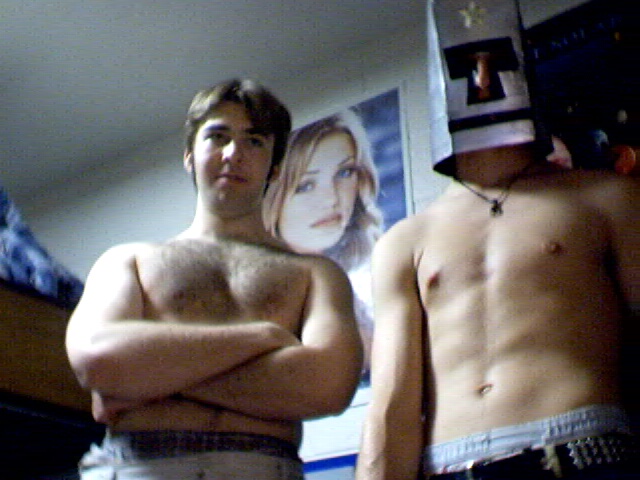
Nick Courage: Yea, we just couldn't brook someone who thought dinosaurs were the bones of sinners. To be honest, Scott — I still can't. Also, the motivation for those masks/pictures was: we were going to make a photographic comic book! I just went spelunking in my old DiaryLand diary — I can't believe that thing's still online — for corroboration and to jog your memory:
im so bored. i wish school would just end. i wish everyone on my hall wasnt such an effing tool. my hall, dewey decimal style:
1) the short nazi rotc jesus kid who makes out with his bizarro girlfriend in the bathroom.
2) his roommate, the recluse.
3) the short, redneck (in the literal sense) gymnastics kid who stays in the bathroom popping zits for hours at a time with his ass stuck out so you cant get by, wearing girls pajama pants and smiley face slippers and those oversized early 90's shirts with cartoon characters that you thought no one would ever wear.
4) his roommate, the recluse who wears the same shirt everyday and walks around looking petulent with his mouth open. so far, if you say YO to any of these kids when you see them, they pretend not to see you.
5) the two kids who are semi cool, except for that they are friends with the previous, and who, every once in a while, have kumbaya-esque sing-a-longs of "i would walk 500 miles" over and over and over again late into the nite.
6) James and his Jesus roommate who just transferred to Unit K cos his best friend and roommate came out. Scott says he has dirty underwear, despite the arguable cleanliness of his soul.
7) Lawrence and Bill. nobody likes Lawrence because he looks and acts as awkward as a longshore man in the big city (colonial williamsburg?). Bill is like a deer in headlights.
i feel like im living with a hall full of really boring rejects. (and i left out the people i dont care about at all.) except for Ballet Pete, he's cool. i wish Rob (aka Dave aka JESUS) still lived here. he didnt sleep for a week, and then he got someone to punch him as hard as possible in the face to prove that physical reality didnt exist, or something… i dont feel like going into his drug-induced philosophy — suffice it to say he probably watched the matrix on acid. and then he'd walk around naked and take pictures of spiders, and he had daily "teachings" at 7. god i loved that kid, i wish he had stayed. i was anticipating such an eventful year.
Scott Lerch: Haha! That's awesome that your DiaryLand entries are still up. Our hall sounded hilarious the way you put it. I totally forgot about most of those guys. The Rob story was the only one I could come up with on my own. So how is it we weren't boring rejects either, playing Halo and studying all the time? The only thing that seemed to differentiate us is we weren't complete freaks (minus homo eroticism, which happened freshman year anyway) and we weren't douche bags (although we were kind of elitist).
Nick Courage: I'm sorry, Scott — that guy's girlfriend used to eat hamburgers in the men's bathroom while he fucked with his face and you're saying that you don't see much that differentiates us? There's a reason we were so elitist at William and Mary — and, just to jog your memory a little more, we weren't "kind of elitist"… we were totally, unrepentantly, 100% cocky. Part of that was that there were so many effing evangelists around; part of that was Colonial Williamsburg angst — both of which combined into an alienate-or-be-alienated reflex, I think. Either way, I still love our freshman year friends, but once we descended into the pits that were the upperclassmen dorms… there was nothing there to be proud of. That's not to say that cool, normal stuff wasn't happening at W&M… but by the time sophomore year rolled around I was definitely not in a place to go looking for it. I wasn't sick of you at all, though; probably woulda just dropped out if I'd been slotted into a room by myself. Which means you're partially responsible for my student loans. I want you to remember that when you launch some fancy startup…
Scott Lerch: When you put it that way, yeah, we didn't have some fatal personality flaw like almost everyone else on our hall, but maybe that's just me being an arrogant elitist. Actually, you're right, we were both complete elitists (justifiably so), I just tried to play it down a little for the public record. And I'm glad you weren't sick of me, but I think (almost) any of the guys from freshman year hall could have taken my place to save you from Unit K hell. I definitely couldn't imagine living there by myself. But if you want to place some of the blame for your student loans I'll be glad to help out when I'm a millionaire. I'll need some of our old cockiness, though, to have the balls to quit my crappy corporate job and start something.
Nick Courage: I don't know if it could've been anyone else, actually. You impressed on me like I was a baby dinosaur. I really think all the elitism was in the right place, though; it was mostly academic, so we studied all the time and maximized the learning part of college. And then I did the opposite at UF while you stayed the course, so now I'm well-rounded and you're my egghead engineer friend. Win/win!
Nick Courage: And, straight from your own DiaryLand — exhibits A and B:
on the way home i did discuss windows vs linux and windows 2000 vs windows xp with rob. he seems to think linux is gaining on ms and that the only thing keeping ms goin is momentum. whatever… all i know is that linux is a pain in my ass and is extrememly unproductive when you are going to be using your computer for more than one thing. he also thinks windows xp is less stable and secure than windows 2000… his source, some ppl online that know what they are talking about… sure, those ppl could have been me when i feel like taking a side for no particular reason on some stupid thing like this, and because i said a few intelligent comments on some stupid message board im "elite" and know my stuff…
Silinux: i had a rather pathetic night last night…
NRichardson504: whatd you do, play xbox?
Silinux: not even
Silinux: drank some beer and watched cross roads with kevin
Silinux: and then wild on e…
Silinux: we need help
Nick Courage: So things were fine after I left, huh?
Scott Lerch: Ok, well I was totally proven right in my first entry. Windows XP is currently considered the most stable and secure desktop OS on the market now after the Vista fiasco and I still don't see a huge mass of people using Linux for their desktop. Plus, I only wrote that DiaryLand entry because you told me to. As for that IM conversation… so a few of my weekends were a little boring. What is cross roads? I don't even remember that show. However, Wild on E! is acceptable. I think you made your point though, things would have been way better if you stuck around.
Nick Courage: Crossroads is the Britney Spears road trip movie.
Scott Lerch: Oh god! Are you sure? I must have blocked that from my memory because that doesn't even sound familiar. At first I thought I must have meant Crossing Over with that jerk who takes advantage of vulnerable people by pretending to talk to their dead relatives. That would have been way better…
Nick Courage: DiaryLand may be a fickle mistress, but she never lies, Scott. She never lies. It's almost like we're having a séance now… One last bit of evidence:
scott lerch.
you were nice to me and let me play dreamcast while my first year roomate was giving phillip head on my bed.
i had blue hair. you had flannel shirts.
we yo yoed and carved pumpkins together.
then you were my roommate.
we pined away for x box while playing tony hawk on dreamcast.
you got drunk for the first time.
then you got an x box.
we took psychology together, and played HALO in our free time.
you bought lots of other x box games, some were good, some were japanese (Jet Set Radio Future and Wreckless, to name two).
we both had out of state girlfriends, and bitched about the ugly stupid people at william and mary.
i left you to grow your beard and wear your flannel and to be your own man.
yes, you were a determinist.
yes, you had your freaky ideas about sentient Hawking computers taking over our world.
yes, when that day was to come you were looking forward to being their slaves.
and yes, at every meal you drank one glass of pink and one glass of red.
and yes, you propositioned my (ex-)girlfriend twice [… it goes on and on]
Scott Lerch: That seems to sum up our time together pretty well. Dreamcast with Tony Hawk freshman year while you told hilarious stories about Wes; Xbox with Halo sophomore year while we pined away for our girlfriends, hating on almost everyone else. Good times…
Nick Courage: Yea, when you condense it like that it's sort of a weird basis for a friendship. But the tightest bonds are born out of adversity! You having lived with Calcote is pretty much the equivalent of surviving boot camp. And you know, I haven't really played video games in four or five years. When I moved I put all my gear outside my door with a note that said "VIDEO GAMES NEED LOVING HOME" — they were gone in five minutes.
Scott Lerch: Our friendship was sort of out of necessity since we both had crappy roommates while everyone else seemed paired up rather well in our hall. I thought you had a terrible roommate situation compared to me. Calcote was actually kind of fun to hang out with every once in awhile, at least when we played Counter-Strike online. Video games were definitely key to strong relationships in college. In a way I'm glad you never found another true Halo buddy, but it's sad you gave away all your stuff.
Nick Courage: So what now?
Scott Lerch: I have absolutely no idea.
Nick Courage: I have an idea. I'm going to ask you — barrage you with — a series of short questions, and I want you to answer them off the top of your head. This… because I think we've been having heady discussions and reminiscing, but I feel like the discussion is taking precedence over you as a person, as a character in the AMR tableau vivant of people I think everyone should be friends with. First: when and where were you born? When and where did you first see a computer? How did you mostly spend your time between A and B?
Scott Lerch: I was born January 15th, 1982 in Long Branch, NJ, but I have no memories of my first round living in New Jersey. As for the second question, it depends how you want to define computer. Technically the first computer I can just barely remember was a SEGA Master System I got for Christmas in Houston when I was about 5. The first PC I remember was an Apple IIGS my parents bought when I was probably about 6 or 7, which I used to draw pictures and play adventure games. But I didn't get really excited about computers until I was 10 and visited the computer lab at the Boston Museum of Science. That's when I first saw a computer that had a touch screen, could speak, play videos, and hold an entire encyclopedia on a CD-ROM. After that I was hooked.
Nick Courage: What did you aspire to be as a child? If no aspirations: supply a picture of you as a child looking vacuous.
Scott Lerch: Some sort of visual artist. I took extensive art classes starting around age 6 and was the best student in all my classes through high school. I got a 5 in AP art and almost went to the Governor's School of New Jersey after my junior year of high school, but made a conscious decision that I would rather program computers. I haven't done any art since then.
Nick Courage: Most cherished memories: 0–10, 10–20, 20–30, 30–40? No need to impose a narrative structure — and please extrapolate for the latter dates.
Scott Lerch: 0–10: Besides early computer-related memories, I recall having a lot of fun attempting to build a spaceship with my sister in the garage after watching the 1985 movie Explorers. The best part was I thought we might actually succeed.
10–20: The early part of the decade was dominated by video game memories — getting a SEGA Genesis for Christmas and playing Sonic the Hedgehog non-stop, or getting a CD-ROM drive another Christmas and playing Rebel Assault non-stop. But my most cherished memories have to revolve around Danielle, junior year of high school: hanging out after school eating mac-n-cheese, watching Pokémon (don't ask), jumping on a huge backyard trampoline, and making out for hours in the basement on a bright pink bean bag chair.
20–30: Moving to San Francisco — eating my first real burrito at a hole-in-the-wall taqueria, going to bonfire parties at Ocean Beach, and running along the bay trail in beautiful weather.
30–40: I assume having kids. At least that's what everyone else tells me…
Nick Courage: When coding/creating: are computers an escape, or something to be escaped?
Scott Lerch: I always enjoy coding because it's my only creative outlet. The results can always be satisfying even if the subject matter is mundane. Some of my best days at work are when I spend 10 hours coding one elegant solution to a problem and I don't interact with a single person.
Nick Courage: Pretend: you're walking to work, to Manhattan across the Brooklyn Bridge. You stop to admire crepuscular light refracting in morning smog, think back to particles and waves and particular waves. Then: a lady is about to jump. She's been there the whole time, watching you watch nothing, distracted from jumping. But now she's going to jump again. What do you say to her?
Scott Lerch: "Why?" I'll need to know that if I'm going to have any chance of convincing her to stop.
Nick Courage: Also pretend: I can grant you a wish, given it's a sort of be-all, end-all lifestyle fantasy wish. Verbalize your wish here:
Scott Lerch: Give me the genius to develop the first general AI before anyone else, and have it become my BFF.
Nick Courage: Now: actualize that wish. What was your immediate reaction to this prompt?
Scott Lerch: It's never going to happen — although I'm comforted by the idea that I'll most likely live through the Singularity.
Nick Courage: What do you think about when you're not thinking about anything? Does this usually happen in the car, in coitus, or not at all?
Scott Lerch: This never happens, and I'm always skeptical when someone claims they aren't thinking of anything when they look zoned out.
Nick Courage: You wake up in the middle of the night, covered in mud in a canvas pup tent. You're a grenadier; your breath smells like grappa. Somewhere in the distance you hear a Nazi diplodocus roaring (yes, this is a World War II / Jurassic Park mashup). Looking down at your uniform, you realize that you're part of the resistance. Is this temporal and spacial anomaly acceptable to you? And: what do you do?
Scott Lerch: No, it's definitely not acceptable. I would curl up in the fetal position and concentrate as hard as possible to regain consciousness and/or sanity. If that didn't work I'd probably run screaming at the first Nazi dinosaur I could find and blow it and myself up with all my remaining ammo. Hopefully I wake up after that.
Nick Courage: Manual or automatic — and if the latter: do you wish it was the former?
Scott Lerch: Always automatic. Why do something when a machine can do it for you better? Unless it can't yet — but then that's only temporary…
Nick Courage: You die. Immediately you realize there is a traditional god — the one envisioned by bilious megachurch preachers nationwide. It turns out that dinosaurs are the bones of sinners. Are you surprised to be here? Do you file a complaint? Do you apologize? Do you try to escape?
Scott Lerch: I would be in a complete state of shock that would quickly turn to anger. After berating God for the lack of evidence I'd try to be fair and hear his side of the story, although suspicious regardless of what I hear. Unless God manipulates me in some way that causes me to repent — which I doubt an evangelical Christian God would do, for reasons of free will — I'd probably try to find a way to rebel, like Lucifer. If that looked futile I'd try to find a way to destroy myself so I could finally be at peace. Although, in reality I wouldn't have a chance to do any of that, since I'd be roasting in hell from the start…
Nick Courage: It's 2060, the real Mayan apocalypse (translation error with 2012). You're famous for something. What is that something?
Scott Lerch: Inventing the web seek button found on every modern browser circa 2011 — I'm not taking any chances when it comes to realizing my dreams, in case the world actually ends in 2012. I'll apply the genius of my grandfather to the web, so you'll only have to click once to view the top search result for a preset time before automatically surfing to the next result. It's for everyone too lazy to keep clicking the web scan button found on the browser search bars of 2010.
Nick Courage: Do you have any secrets? Would you like to share one with the world?
Scott Lerch: Nothing of consequence (mostly), and even if I did I doubt I'd share it within a Google's reach. I do have a job requiring a clearance to keep…
Nick Courage: Finally — I don't know anyone who reads the books you read for pleasure. Can you recommend five you think we'd like?
Scott Lerch: I doubt I can recommend 5 that I honestly think everyone would like, but there should be at least 1 within my top 5 that everyone can hopefully appreciate:
- The Age of Spiritual Machines: When Computers Exceed Human Intelligence by Ray Kurzweil — the best intro to the Singularity by its primary cheerleader. It's not dense or technical and has a fun, progressive narrative at the end of each chapter. My favorite part is the predictions timeline in the back, which is turning out to be fairly accurate so far.
- Code: The Hidden Language of Computer Hardware and Software by Charles Petzold — most will probably find this boring but I think it's an amazing book. You could know absolutely nothing about computers starting off, but by the end you'd know enough to build and program a computer yourself from scratch with parts from Radio Shack.
- Why People Believe Weird Things (followed closely by The Science of Good and Evil) by Michael Shermer — this helped me understand how completely rational, smart people can justify their religious beliefs or crazy superstitions, and why it's going to be hard to rid humanity of these vestigial memes.
- Engines of Creation: The Coming Era of Nanotechnology by Eric Drexler — I love this book because it was so ahead of its time. The concepts seemed absolutely crazy when it was written, but the growing idea of the Singularity puts all of it within reach rather soon. Molecular nanotechnology has the potential to solve almost all our material needs.
- Why I Became an Atheist: A Former Preacher Rejects Christianity by John W. Loftus — if a Christian honestly reads this with an open mind and doesn't have serious doubts about their faith afterward, they will never change. It's the most thorough rebuttal of Christianity I've ever read, and much of it applies to other religions. Well written, extensively researched, and structured perfectly.
Nick Courage: You did it! You're done. Should I do something with your name so you remain safe from Google? Like call you Scott L3rch?
Scott Lerch: Phew… that was painful. No need to change my name — Google already knows. It always knows.